Creative Thinking / Industry
Most Designers Didn't Fail in 2026. Their Positioning Did.
Demand for designers went up in 2026. Hiring got brutal. Both are true, and the gap between them explains everything the market stopped paying for output, not for design.
There's a story going around that 2026 was the year AI came for designers. It isn't quite true, and the part that isn't true is the part worth understanding.
Here are two facts from the same year. Ninety percent of companies still rely on designers in some capacity, 47% increased their design budgets in the last twelve months, and 53% expect to spend more in the next twelve. Eighty-two percent of design leaders say their organisation's need for designers has increased or stayed flat. Only 14% of hiring managers expect their need for freelance designers to shrink in the year ahead.
And yet: the share of designers landing a new role within three months had already fallen from 67.9% in 2019 to 49.5% by 2024, and nothing since has reversed it. Entry-level design openings are, in the words of Nielsen Norman Group's State of UX in 2026, "scarce and highly competitive." Portfolios that would have won interviews in 2021 now go unanswered.
Demand is up. Hiring is brutal. Both are true, and the gap between them is the entire story of 2026.
The market did not stop paying for design. It stopped paying for output. Designers who had spent a decade selling execution discovered that execution had become the cheapest thing in the room. That is not a failure of talent. It is a failure of positioning, and positioning is fixable.
What actually got repriced
Look at what shipped in the tools this year rather than at the headlines about them.
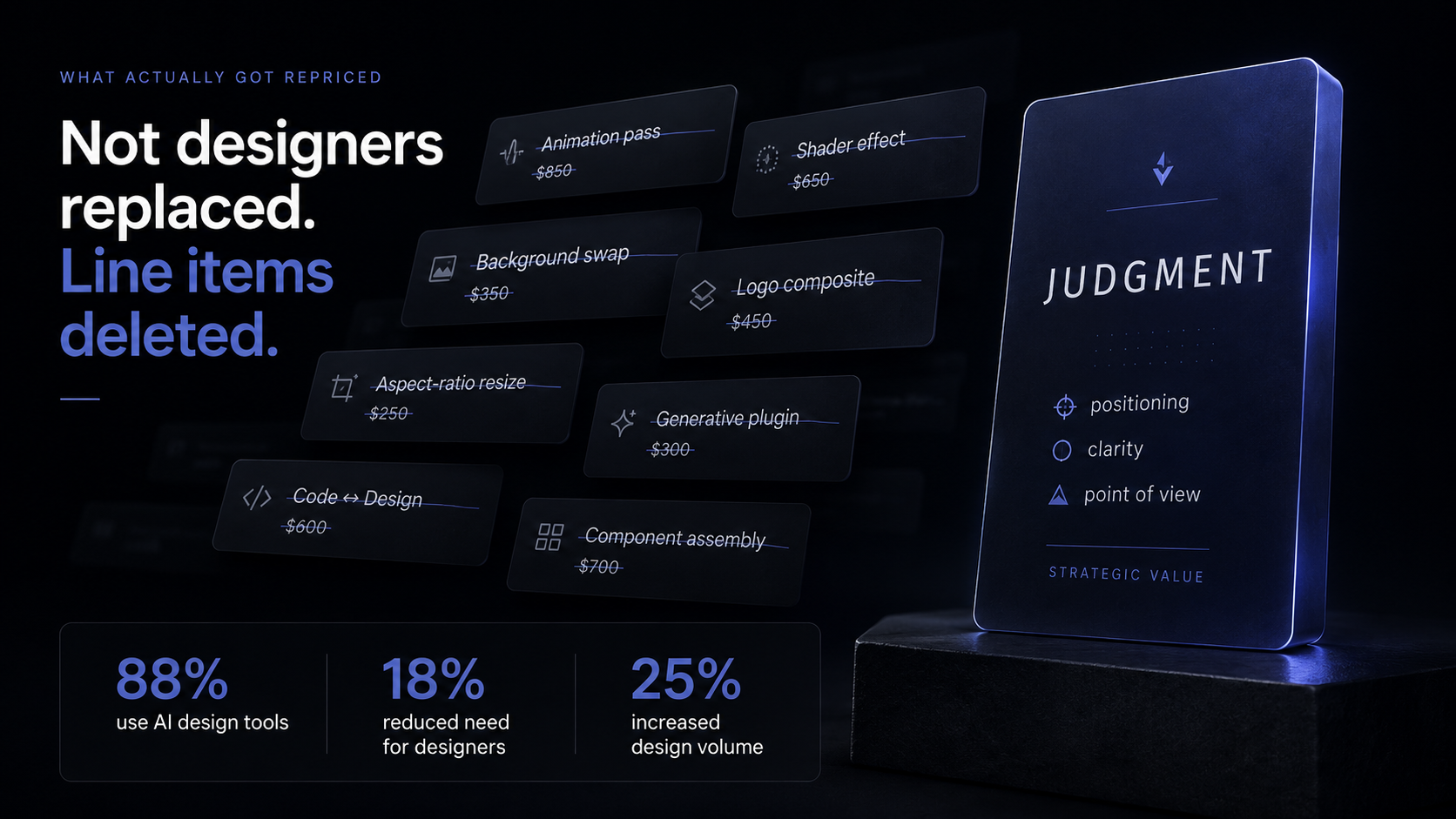
At Config 2026, Figma introduced Motion with an AI agent that generates a first-pass animation from a text prompt. Custom shader effects, generated and rendered without writing code. Weave's image tools pulled directly onto the canvas: background replacement, logo compositing, aspect ratio changes. Generative plugins so a team can build its own tooling without an engineer. And Code Layers, which brings a working codebase onto the canvas as an inspectable layer and converts between code and design in both directions. Dylan Field's framing was blunt: "Code is not the opposite of design. Code is material for design."
Read that list again as an invoice. Every item on it is a line a designer used to bill for. Not a designer replaced. A line item deleted.
That is the mechanism. AI didn't remove designers from the industry in 2026. It removed the parts of design work that were reproducible, and it did so faster than most people repriced themselves. Nielsen Norman Group put the consequence in one sentence: "If you're just slapping together components from a design system, you're already replaceable by AI."
The businesses buying design confirm it from the other side. Eighty-eight percent now use AI design tools. But only 18% say AI reduced their need for designers, 32% say it replaced basic tasks only, and 25% say it actually increased the volume of design they need. The pie got bigger. The slice labelled "production" got thinner.
The five positions that broke
If you want to know why a specific designer struggled this year, it usually maps to one of five things they were selling.
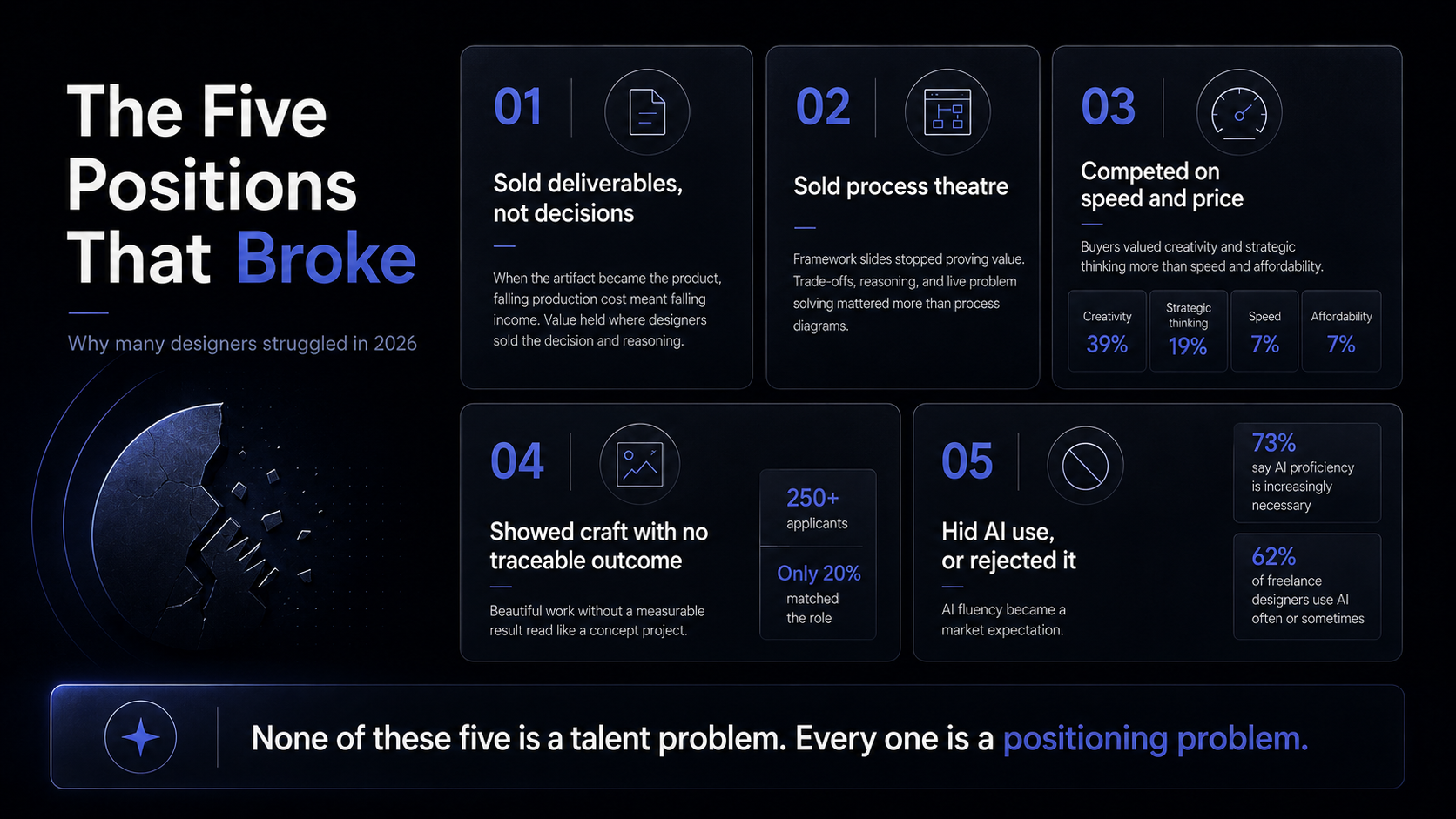
1. They sold deliverables instead of decisions. Screens, decks, mockups, a Figma file at the end. When the artefact is the product, the artefact's falling cost is your falling income. The designers who held their rates were selling a decision: this navigation, this pricing page, this identity, and here is the reasoning and the risk. The file was evidence, not the goods.
2. They sold process theatre. The double-diamond slide had a good run. It doesn't survive 2026. Hiring manager Tom Scott's objection, reported by The Fountain Institute, isn't that the double diamond is bad process. It's that showing it as your case study structure "signals that you have confused a framework diagram with evidence of thinking." Hiring managers increasingly skip the portfolio walkthrough entirely and run a live problem in Figma instead. A framework diagram proves you've read about design. A trade-off proves you've done it.
3. They competed on speed and price. This is the most quietly fatal one. When clients were asked what they value most in a designer, creativity came first at 39% and strategic thinking second at 19%. Speed scored 7%. Affordability scored 7%. A large share of the profession spent 2026 competing on precisely the two attributes their buyers cared about least, against a machine that will always be faster and cheaper at both.
4. They showed craft with no traceable outcome. In one recent hiring round of over 250 applicants, only 20% actually matched the job criteria. A beautiful redesign that moved no metric now reads the same as a concept project. Not because beauty stopped mattering, but because beauty stopped being scarce, and consequence didn't.
5. They hid their AI use, or refused it outright. Seventy-three percent of design managers say AI proficiency is increasingly necessary; "no AI signals" now appears on hiring managers' red-flag lists; and designers with demonstrable AI skills have been reported earning materially more than peers without them. Meanwhile 62% of freelance designers already use AI often or sometimes: a majority quietly doing the work while presenting a portfolio that says nothing about how it was made. The purist and the silent user both cost themselves work this year, for opposite reasons.
None of these five is a talent problem. Every one of them is a positioning problem.
The group that genuinely got hit
There is one cohort for whom "you should have positioned differently" is not an honest answer, and it deserves to be named plainly.
PwC's 2026 AI Jobs Barometer, built on over a billion job postings, describes a pattern it calls seniorization. In highly AI-exposed occupations, 52% of the new skills appearing in entry-level postings are ones historically associated with experienced workers: strategy, stakeholder management, leadership. In the least-exposed fields, that figure is 7%. Entry-level roles in AI-exposed work are around seven times more likely to demand those senior skills. Postings for these seniorized entry-level roles grew 35% since 2019. Traditional entry-level openings fell 10%.
Translated into design: the junior work was the apprenticeship. Resizing, versioning, production files, first-pass comps. It was how people learned judgment by doing a hundred small things badly and then well. AI absorbed almost exactly that layer. The rung didn't get harder to reach; it got removed, while the rung above it started asking for skills you could previously only acquire by standing on the missing one.
One design educator described watching her students search into "this kind of empty void." The workaround that emerged is what one writer aptly called an audacity tax: unpaid work, relentless self-promotion, building an audience before building a career. It is paid most easily by people who can afford not to earn. That's a pipeline problem with a class filter on it, and it will show up in the industry's work in about five years.
This one isn't on the juniors. It's on studios, and it has a practical answer that we'll get to.
The thing almost nobody priced in: sameness
Here's the second-order effect that will define 2027 more than the layoffs defined 2026.
Nearly 40% of companies now use AI to start creative projects. Seventy percent of freelance designers believe AI is degrading the quality of creative work, while 62% use it anyway. When every brand begins from the same handful of models, trained on the same corpus, prompted with the same vocabulary, the output converges. Not toward bad. Toward plausible. Toward the median of everything that already existed.
And the single most common complaint clients had about designers this year was brand misalignment, at 19%, the top pain point on the list.
Put those together. The market is generating more design than ever, most of it starting from a tool optimised for the average, and the thing buyers complain about most is work that doesn't feel like them. AI is extraordinarily good at making something reasonable. It is structurally poor at making something specific. Specificity is the one input that did not get cheaper in 2026: a point of view, a defensible aesthetic, a reason this brand looks like this and not like the well-executed default.
That's why "taste" stopped being a soft word this year and started being a line in a budget.
What the designers who didn't fail did instead
Six moves, all of them available to anyone reading this.
Move up the decision chain. Stop pitching "I'll design your website." Pitch "I'll figure out why your signups drop at step two, and the design is how we fix it." Same work, different position, and it prices differently because a decision has a value and a file has a cost.
Show shipped work and trade-offs. Three real case studies with outcomes beat seven polished concepts. Cut student work older than two years, cut unsolicited redesigns with no constraints, cut anything you can't defend under pressure. Where you chose A over B and why is more persuasive than any process diagram.
Get one spike, keep the range. There's a genuine tension in the 2026 data. Nielsen Norman Group argues the survivors are adaptable generalists who treat UX as strategic problem solving; hiring research says specialists with depth are beating broad generalist teams. Both are right, and together they describe a T: strategic range wide enough to talk about business, with one area of depth deep enough that you're the obvious call. Range alone reads as unspecialised. Depth alone reads as replaceable by tool.
Make your AI use visible. Not "I use AI." Show the loop: what you prompted, what you rejected, what you rebuilt by hand and why. The editorial judgment is the skill now, and it's invisible unless you show the discards.
Price on outcome, not hours. Hourly billing is a bet that your speed is valuable. In 2026 you are bidding against something that is instantaneous and nearly free. Value-based and retainer pricing bet on your judgment instead, which is the asset that appreciated.
Build a point of view you can be hired for. Publish it. A designer with an argument about their category is a category of one. A designer with a Behance grid is a search result.
And if you run a studio
The apprenticeship broke, so it has to be rebuilt deliberately. Practically, that means juniors are no longer hired to absorb production, because AI absorbed it. They get paired into judgment work early instead: sitting in the client call, writing the rationale, defending a trade-off in a review, owning a small decision end to end. It's more expensive per head in year one and it's the only way anyone has a senior bench in 2030.
It also means being honest in pitches about where AI sits in the process. Clients are already using it. Pretending otherwise doesn't read as craftsmanship; it reads as a studio that hasn't updated its stack.
The actual lesson of 2026
The designers who struggled this year were not, for the most part, bad designers. Many were excellent, better at the craft than the people who out-earned them. What they had was a position built on the assumption that being able to make the thing was the scarce part.
For about thirty years, it was. In 2026, it stopped being.
The market didn't stop paying for design. It stopped paying for the file, and it is paying more than ever for the decision behind it. Everything else is downstream of that one repricing: the tools, the layoffs, the discourse.
Design didn't fail in 2026. A business model did.
Patronus Pixels is a creative studio working on brand identity, web, UI/UX and motion. If your design is being priced like production, the problem usually isn't the design.
FAQ
Frequently Asked Questions
Is design still a good career in 2026?
The demand data says yes. Ninety percent of companies rely on designers, 47% raised design budgets this year and 53% plan to raise them next year, and 82% of design leaders report stable or growing need. What changed is the composition of the work: roles requiring judgment are growing while execution-only roles stagnate. The U.S. Bureau of Labor Statistics still projects around 7% employment growth for digital designers through 2034.
Will AI replace graphic and UI designers?
It hasn't, and the buyers say so: only 18% of businesses report that AI reduced their need for designers, 32% say it replaced basic tasks only, and 25% say it increased their design needs. What AI reliably replaces is reproducible production work. What it doesn't replace is the decision about what to make and why.
Why is it so hard to get a junior design job right now?
Because the junior tier was the layer AI absorbed most completely. PwC's analysis found traditional entry-level openings down 10% since 2019, while "seniorized" entry-level roles, ones demanding senior-level skills, grew 35%. Entry-level roles in AI-exposed fields are roughly seven times more likely to ask for skills people used to acquire on the job.
Should designers put AI work in their portfolio?
Yes, and show the judgment rather than the output. Seventy-three percent of design managers now consider AI proficiency increasingly necessary, and "no AI signals" is treated as a red flag by some hiring managers. The strongest version isn't a gallery of generations. It's the record of what you prompted, what you threw away, and what you rebuilt by hand.